Bozeman · City Charter · November 3, 2026
The proposed charter makes your elected commission answer to a body no voter chose.
Nobody votes for the Inter-Neighborhood Council. Under Article VIII of the 2026 draft charter, your elected commission would have to consult it before consulting you, and answer it in writing whenever it declines to follow its recommendations. The draft contains real improvements too — and the ballot gives you no way to take one without the other.
Start here
There is no “no” on this ballot
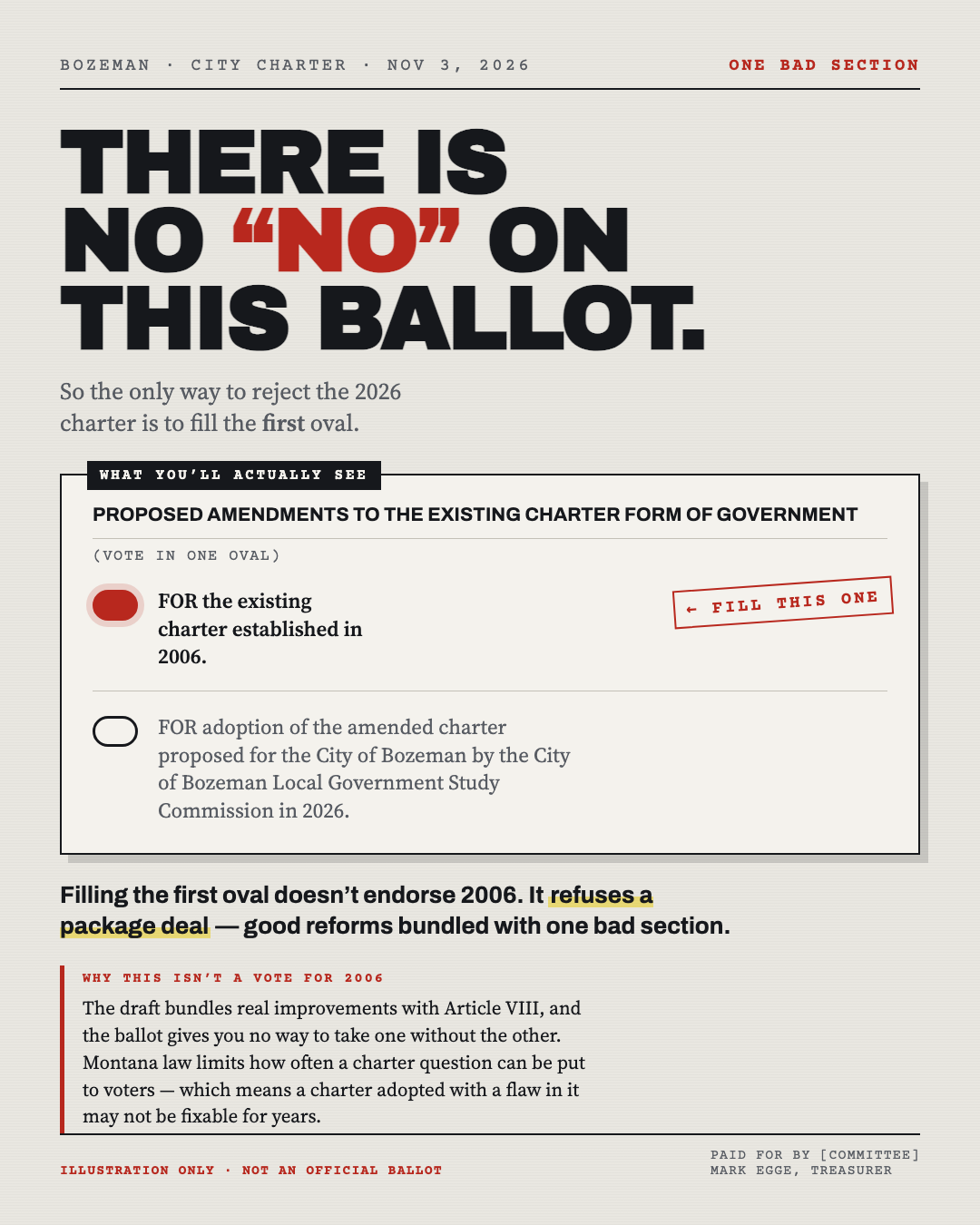
The charter question does not offer yes and no. It offers two ovals, and both of them begin with the word FOR. The only way to reject the 2026 draft is to fill the first oval, which reads “FOR the existing charter established in 2006.”
That wording is a quirk of Montana’s charter statute, not an endorsement you are being asked to make. Filling the first oval does not mean you think the 2006 charter is perfect. It means you decline to adopt this particular replacement.
Ballots mail October 9Gallatin County mails ballots to absentee voters on October 9, 2026, nearly a month before Election Day. If you are on the absentee list, your charter vote is probably cast in October. Polls are also open on November 3.
The case
Four powers no other city board has
Bozeman has a roster of citizen advisory boards — Community Development, Transportation, Economic Vitality, Historic Preservation and others. Every one of them is governed by §8.05, which says plainly: “Unless otherwise required by law, city boards are advisory only.” Article VIII contains no such sentence about the Inter-Neighborhood Council. Instead it grants four things no board gets.
-
01
The Commission must answer them, in writing, with reasons
Proposed charter§8.04(d)(8)
“The city commission and city manager shall provide timely responses to recommendations submitted by the Inter-Neighborhood Council, including an explanation of how such input was considered and the reasons for divergence…”
What it does: Anyone may send the Commission a recommendation. No one else can compel an answer. There is no cap on how many recommendations the INC may send, and no qualifier on “shall” — not “when practicable,” not “as resources permit.” This is agenda-setting power that otherwise takes a majority of sitting commissioners.
-
02
The city must consult them before the public hears about it
Proposed charter§8.04(d)(7)
“The City shall consult the Inter-Neighborhood Council during the formative stages of citywide planning efforts, policy initiatives, and budget discussions that affect neighborhood associations…”
What it does: “Formative stages” means before a proposal reaches a public hearing. This is a seat at the table earlier than the table is open to everyone else. Note that the study commission voted on June 4, 2026 to strip the flexibility language out of this clause. The final text is an unqualified “shall.”
-
03
A liaison that already existed, upgraded so it can’t be shared
Proposed charter§8.04(c)
“The City shall designate a full-time, fully dedicated staff member to serve as a liaison to the Inter-Neighborhood Council and neighborhood associations.”
What it does: The 2006 charter already requires this at §4.06(e) — “The City shall designate a staff member to serve as liaison.” The 2026 draft adds three words: full-time, fully dedicated. That forecloses splitting the role across other duties, and no other advisory body in Bozeman is guaranteed anything like it. “Shall,” with no “subject to appropriation.” And because it sits in the charter rather than in code, a future commission cannot undo it by ordinance or by budget. Only a vote of the people could remove it. The verb is “designate,” not “hire,” and a liaison post already exists — so the added cost turns on how far today’s arrangement falls short of “fully dedicated,” which we have not established. What is not in doubt is that the obligation itself passes out of any future council’s hands.
-
04
Exempt from the ethics code the city pays to train them on
Proposed charter§8.04(d)(2)
INC representatives “are not bound by, but are expected to observe the City and State Code of Ethics.”
What it does: Every city official, employee and board member must certify compliance with the ethics code annually (BMC 2.03.480). “Expected to observe” carries no enforcement and no removal provision. This is a deliberate design, not an oversight, and we should be fair about that: §9.01(b) adds the Inter-Neighborhood Council by name to the bodies whose ethics training the city must fund, while the oath requirement in that same subsection reaches only officials, board members and employees. The drafters chose to train them, ask them to observe the code, and expressly not bind them to it. We think that is the wrong choice for the one body the Commission is also obliged to answer in writing.
What you weren’t told
Four new duties. Five official summaries. Zero mentions.
We checked every place a Bozeman voter would reasonably look to find out what the charter changes — the city’s two ballot pages, its FAQ, and both summary lists in the Study Commission’s own Final Report — for each of the four duties above. We searched for the operative phrases and for generous paraphrases of them, so near-wordings would have counted.
| The new duty | Proposed Changes | What’s On the Ballot | City FAQ | Report: Key Provisions | Report: Findings |
|---|---|---|---|---|---|
| Must answer the INC in writing §8.04(d)(8) | No | No | No | No | No |
| Must consult it before the public §8.04(d)(7) | No | No | No | No | No |
| Liaison upgraded to “full-time, fully dedicated” §8.04(c) | No | No | No | No | No |
| Representatives “not bound by” the ethics codes §8.04(d)(2) | No | No | No | No | No |
The only near-hit in the entire Final Report is the phrase “full-time professional manager” on page 9, which describes the city manager and has nothing to do with the INC. The operative language exists in one place: the charter text itself, at pages 25 and 26. The words “Article VIII” appear on none of the four official city pages.
Commissioner Deanna Campbell
“In none of the materials, the talking points or this, is it ever referred to as Article 8. And I think that people should be directed to where they can go in the charter and see this work.”
Why it matters: That is a member of the Study Commission, raising this about her own commission’s voter materials, five weeks before ballots mail. The consultant undertook to fix it. As of today the pages still do not name the article.
The one place a voter asks directly
The city’s FAQ contains exactly the question a curious voter would click: “Why is there a new article in the Amended Charter for Public Engagement?” The answer discusses growth, wards and expanding to six commissioners. It never mentions Article VIII, neighborhood associations or the Inter-Neighborhood Council.
It is word-for-word identical to the answer beneath it, which is about the sub-options — so this looks like a copy-paste error rather than evasion, and we are not going to call it anything else. The effect on a voter is the same either way.
It does not show that anything was hidden, and we are not claiming that. The Inter-Neighborhood Council is named on every one of those surfaces, and the drafting process was unusually public: Article VIII was in the adopted study plan in July 2025, the INC itself approved draft language that December, and it drew more public comment than any other part of the charter — about twice as much as the ward question.
The gap is narrower than that and, we think, more troubling. The body was disclosed. What it would newly be owed was not. A voter who did the reasonable thing — read the city’s summary of what changes — would finish knowing the charter says something about neighborhood associations, and knowing nothing about a written-response duty binding their elected commission.
Who this body speaks for
A minority of the city, concentrated on one side of it
Neighborhood associations are voluntary. Most of Bozeman does not live in one. The 2020 census blocks, matched against the city’s own association boundaries, give the picture.
- Live in a neighborhood association
- 33%17,652 residents of 53,293 citywide. Two-thirds of Bozeman is represented by no association at all.
- Associations east of 19th Avenue
- 12 of 15Three are west of 19th, where most of the city’s recent growth has gone.
- Best single-association turnout
- 1.5%53 responses out of 3,600 on the development code, the strongest showing any association managed — reported to the study commission by Mayor Joey Morrison.
- Delegates who signed the Guthrie letter
- 5Five delegates, out of fifteen recognized associations, asked the Commission to deny a housing project and rescind the Affordable Housing Ordinance.
Say it accuratelyINC delegates are not self-appointed. Each association selects its delegate under bylaws that must ensure democratic voting procedures. The problem is not how delegates are chosen. It is that a body speaking for a third of the city is being handed powers over a commission that answers to all of it.
In fairness
The draft charter gets a lot right
This is not a defence of the 2006 charter. The study commission did real work, and several of its changes are genuine improvements.
| Change | Why it’s an improvement |
|---|---|
| Mayor elected at large for four years | Replaces the confusing deputy-mayor apprenticeship with a straightforward election. Takes effect at the 2029 city election (§11.04(a)); a vice mayor is selected from January 2028. |
| Municipal Court gets its own article | In the 2006 charter the court is one sentence — “There shall be a municipal court as prescribed by state law” — filed at §4.05, inside Article IV, Departments, Offices and Agencies. The draft moves it out of the list of departments into its own Judicial Branch article. Approved unanimously at Judge Colleen Harrington’s request. |
| A real process for filling vacancies | The 2006 charter says only that a vacancy is filled “pursuant to state law.” The draft sets a 60-day window, requires a public forum, and limits the appointment to the next municipal election rather than the full unexpired term. |
| Compensation Board | Puts a public, resident-majority recommendation between commissioners and their own salaries. Four resident members vote; the two commissioners and the finance director sit as non-voting ex-officio members (§2.04). |
| The overloaded departments article is unpacked | 2006 filed the Municipal Court (§4.05), neighborhood associations (§4.06) and city boards (§4.07) together under Departments, Offices and Agencies, alongside the personnel system and the legal officer. The draft gives the court its own article, moves engagement and boards to Article VIII, and leaves Article V to actual departments. That is simply better drafting. |
| “Principal residence” eligibility restored | Not a new safeguard — the 2006 charter already required it. A draft version loosened the wording and the study commission put the original language back. |
None of these has to die with this draft. Montana law lets the City Commission propose a charter amendment by ordinance — no study commission and no petition drive required — and Bozeman’s current charter says the same at §8.01(2). Rejecting this package does not kill the good reforms. It lets them be considered one at a time, on their own merits.
We won’t promise you a date. Montana law also limits how often a charter question may go to voters, and how that limit applies here is genuinely unsettled. We explain exactly what is and isn’t known about the timing rather than guess at it.
That same limit is the best reason to be careful on November 3. If a charter election can’t be re-run for three years, then a charter adopted with a flaw in it can’t be fixed for three years either. Article VIII, once adopted, comes out only by another citywide vote — and that vote may not be available for years. When a decision is hard to reverse, the doubt should count against adopting it.
Questions
Straight answers
- How do I vote against the 2026 Bozeman charter?
Fill the first oval, which reads “FOR the existing charter established in 2006.” There is no “no” option on this ballot. Both choices begin with the word “FOR,” and the first one is the one that declines the 2026 draft.
- Doesn’t voting that way mean I support the old charter?
No. It means you decline to adopt this replacement. The ballot wording comes from Montana’s charter statute and is not a statement of enthusiasm for 2006. If the draft fails, any individual reform in it can still be proposed again — by commission ordinance, by citizen petition, or by a future study commission.
- What is the Inter-Neighborhood Council?
It is a body made up of one delegate from each of Bozeman’s recognised neighborhood associations — and it is not new. Bozeman’s current charter has established the Inter-Neighborhood Council since 2006 (§4.06(d)), and has required the city to designate a staff liaison to it since then too (§4.06(e)). What the 2026 draft changes is not the body. It is what the city owes it: a duty to consult it at formative stages, a duty to answer its recommendations in writing with reasons for divergence, an upgrade of the liaison to “full-time, fully dedicated,” and an exemption from the code of ethics.
One structural change is real and worth naming precisely. In the 2006 charter the Inter-Neighborhood Council sits at §4.06, a subsection of Article IV, Departments, Offices and Agencies. The draft gives it a dedicated article. That is a genuine elevation — but it is an elevation within the charter, not an entry into it.
- Are neighborhood associations a bad thing?
No. They are a reasonable way for neighbours to organise, and people who participate in them are doing civic work. The objection is narrow: a voluntary body that covers a third of the city should not hold standing procedural power over a commission elected by all of it.
- What happens if the charter is rejected?
The 2006 charter remains in force. The reforms in the 2026 draft are not lost: the City Commission may propose charter amendments by ordinance under Montana Code 7-3-103(2)(b), voters may propose them by petition, and a study commission question returns to the ballot on roughly a ten-year cycle. We do not claim to know when a follow-up question could appear. Montana Code 7-3-155 limits how often a charter election may be held, and whether that limit reaches a later amendment question is unsettled in Montana law.
- Were the Article VIII changes disclosed to voters?
Partly. The Inter-Neighborhood Council is named in the city’s summaries of what the charter changes. The four new duties are not. We checked the city’s Proposed Changes page, its What’s On the Ballot page, its FAQ, and both summary lists in the Study Commission’s Final Report: none of them mentions the duty to consult the INC, the duty to answer it in writing, the ethics exemption, or the upgrade of the staff liaison to full-time. The words “Article VIII” appear on none of the four official city pages. A study commissioner raised this herself on 19 August 2026.
- When do I need to vote?
Gallatin County mails ballots to absentee voters on October 9, 2026, and Election Day is November 3, 2026, with polls open 7 a.m. to 8 p.m. Regular voter registration closes at 5 p.m. on October 5. If you vote absentee, your decision is effectively made in October.